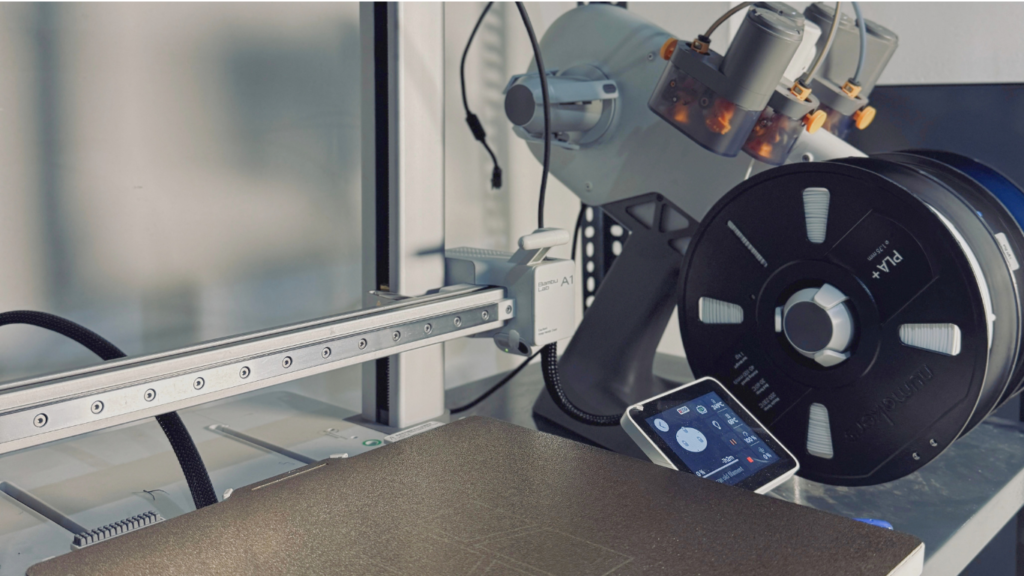
FDM 3D printing is one of the most widely used 3D printing technologies. It can create prototypes, functional parts, custom components, models and many other products.
But how does FDM printing work, and when should you use it?
This guide explains the basics of FDM 3D printing, its materials, applications and benefits.
What Is FDM 3D Printing?
FDM stands for Fused Deposition Modeling.
The process uses a spool of thermoplastic filament. The printer heats the filament and deposits it through a nozzle. Then, the printer builds the object layer by layer until it completes the digital model.
As a result, FDM can create physical parts directly from a 3D design file.
How Does FDM 3D Printing Work?
The process starts with a digital 3D model.
First, slicing software converts the model into printer instructions. Next, the printer heats the selected filament. Then, the nozzle deposits the material layer by layer.
Finally, the printer completes the model and you can remove any support material or perform additional finishing.
The main settings include:
- Layer height
- Infill percentage
- Print speed
- Nozzle temperature
- Print orientation
- Support structures
These settings can affect the strength, appearance and printing time of the part.
Common FDM 3D Printing Materials
Different materials suit different applications.
PLA
PLA works well for prototypes, models, educational projects and general-purpose parts. It also offers easy printing and a wide range of colors.
PETG
PETG provides a useful balance of strength and durability. Therefore, it can suit functional parts and components that need better resistance than basic PLA.
ABS
ABS can suit applications that require specific mechanical and temperature properties. However, it requires more controlled printing conditions.
TPU
TPU offers flexibility. Therefore, it can work well for suitable flexible components, protective parts and custom designs.
What Is FDM 3D Printing Used For?
FDM printing supports many applications.
For example, businesses can create product prototypes before moving to final manufacturing. Engineers can produce functional components, brackets and enclosures.
Similarly, architects and students can create physical models. Designers can also test different product concepts quickly.
Common applications include:
- Product prototypes
- Engineering parts
- Functional components
- Custom brackets
- Enclosures
- Replacement parts
- Architectural models
- Educational models
- Small-batch production
Benefits of FDM 3D Printing
FDM offers several practical advantages.
First, it can produce parts directly from digital designs.
Second, it supports several thermoplastic materials.
Also, FDM can work well for functional prototypes and larger models.
In addition, you can modify a digital design and produce another version without creating traditional tooling.
Therefore, FDM can help businesses test ideas and develop products more efficiently.
FDM 3D Printing for Businesses
Businesses can use FDM printing during product development and manufacturing.
For example, a startup can create an early prototype before investing in large-scale production. An engineering team can also test the fit of a custom component.
Furthermore, businesses can use FDM for small production runs when traditional manufacturing does not make practical sense.
FDM 3D Printing in Calicut and Kerala
MYPRUS provides FDM 3D printing services in Calicut and Kozhikode, Kerala.
We support projects involving:
Prototypes • Engineering Parts • Custom Components • Product Development • Models • Functional Parts
In addition, MYPRUS provides resin 3D printing, 3D scanning, laser cutting and laser engraving services.
How to Start an FDM Printing Project
Starting your project is simple.
First, prepare your 3D model.
Next, share the file and project requirements with MYPRUS.
Then, we can review the design and discuss suitable materials and printing settings.
Finally, we can proceed with production after confirming the project details.
Common file formats include STL, OBJ and 3MF.
Conclusion
FDM 3D printing offers a practical way to create prototypes, functional parts, custom components and models.
The right material and print settings depend on your application. Therefore, selecting the printing method according to the project’s requirements can help you achieve better results.
If you need FDM 3D printing in Calicut or Kerala, contact MYPRUS to discuss your project.
Frequently Asked Questions
What does FDM stand for?
FDM stands for Fused Deposition Modeling. It creates objects by depositing heated thermoplastic material layer by layer.
What is FDM 3D printing used for?
FDM printing works well for prototypes, functional parts, engineering components, custom products, models and small-batch production.
Which materials can FDM printers use?
Common materials include PLA, PETG, ABS and TPU. The best option depends on the intended application.
Is FDM suitable for prototypes?
Yes. FDM can produce prototypes quickly, allowing designers and engineers to test size, shape and functionality.
Does MYPRUS provide FDM 3D printing in Calicut?
Yes. MYPRUS provides FDM 3D printing services in Kozhikode (Calicut), Kerala.