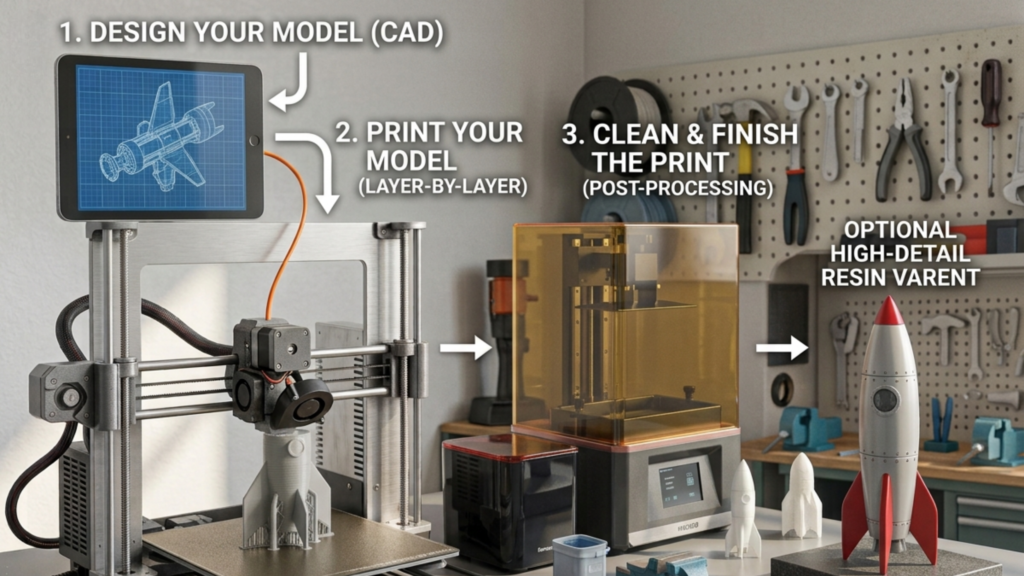
Have you ever wondered how 3D printing works? A 3D printer turns a digital design into a physical object by building it layer by layer.
Today, people use 3D printing for prototypes, engineering parts, architectural models, custom products, miniatures and many other applications.
In this guide, let’s look at the 3D printing process and understand how a 3D printer creates a finished product.
How Does 3D Printing Work?
The basic 3D printing process follows a few simple steps.
1. Create a 3D Model
First, you need a digital 3D model.
You can create the model with CAD or 3D design software. Alternatively, you can use an existing model from a suitable source.
Common file formats include STL, OBJ and 3MF.
2. Prepare the Model
Next, slicing software prepares the model for the printer.
The software divides the model into many thin layers. It then creates the instructions that guide the printer.
You can also adjust settings such as:
- Layer height
- Infill
- Print speed
- Supports
- Print orientation
These settings affect the appearance, strength and printing time.
3. Choose the Material
After that, you need to choose a suitable material.
For FDM 3D printing, common materials include:
- PLA
- PETG
- ABS
- TPU
Resin printers use liquid photopolymer resin to create detailed models.
Therefore, your application should guide your material choice.
4. Start the 3D Printing Process
Now, the printer starts building the object.
An FDM printer heats plastic filament and deposits it layer by layer. Each layer connects with the previous one to create the final shape.
On the other hand, a resin printer uses light to cure liquid resin and create each layer.
As a result, both technologies can produce accurate physical objects, but they suit different applications.
5. Complete Post-Processing
Once printing finishes, the part may need some finishing work.
For example, an FDM print may need support removal or sanding.
Similarly, a resin print usually needs cleaning and curing.
The required finishing depends on the printing technology, model design and desired appearance.
6. Check the Finished Product
Finally, you should check the finished part.
Our team can inspect the model for appearance, dimensions and overall quality.
For engineering parts, you may also need to check fit, function and assembly.
This final step helps ensure that the printed part meets the project requirements.
What Is FDM 3D Printing?
FDM 3D printing stands for Fused Deposition Modeling.
This technology uses thermoplastic filament to create objects layer by layer.
FDM works well for:
- Functional parts
- Engineering prototypes
- Enclosures
- Brackets
- Custom components
- Large models
Therefore, FDM remains a popular choice for practical and functional 3D printing projects.
What Is Resin 3D Printing?
Resin 3D printing uses liquid resin and light to create highly detailed objects.
It works particularly well for:
- Miniatures
- Figurines
- Detailed models
- Small prototypes
- Display products
- Complex designs
Because resin printing can capture fine details, it suits projects where appearance and detail matter.
What Can You Make With 3D Printing?
3D printing supports many different applications.
For example, engineers can create prototypes and custom components. Architects can produce physical scale models. Meanwhile, students can create project models and educational parts.
Businesses can also use 3D printing for product development, custom components and small production runs.
In addition, designers can quickly turn digital concepts into physical samples.
Why Use 3D Printing?
3D printing offers several advantages.
First, you can create prototypes quickly.
Second, you can modify the design and print another version without creating expensive tooling.
Also, you can produce custom parts for specific requirements.
As a result, 3D printing can make product development more flexible and efficient.
3D Printing Services in Calicut
If you need professional 3D printing in Calicut, MYPRUS provides FDM and resin 3D printing services in Kozhikode, Kerala.
We support projects such as:
- Engineering prototypes
- Product development
- Architectural models
- Custom parts
- Miniatures
- Functional components
In addition, MYPRUS provides services such as 3D scanning, laser engraving and laser cutting.
How to Start Your 3D Printing Project
Starting a project is simple.
First, prepare your 3D model.
Next, share the model and your requirements with MYPRUS.
Then, we can review the design and recommend a suitable printing method and material.
Finally, we can proceed with production after confirming the project details.
Conclusion
So, how does 3D printing work? The process starts with a digital 3D model. Next, slicing software prepares the design. Then, the printer creates the object layer by layer. Finally, post-processing and quality checks complete the process.
FDM works well for functional and larger parts, while resin printing suits detailed models and smaller components.
If you need 3D printing in Calicut or Kerala, MYPRUS can help turn your digital design into a physical product.
Have a 3D printing project? Contact MYPRUS today and get started.
Frequently Asked Questions
How does a 3D printer work?
A 3D printer creates an object from a digital model by building it layer by layer. The printer follows instructions created by slicing software.
What is the 3D printing process?
The process usually includes creating a 3D model, preparing the file, selecting the material, printing the object, completing post-processing and checking the finished product.
What is the difference between FDM and resin printing?
FDM printing uses plastic filament and works well for functional parts. Resin printing uses liquid resin and works well for detailed models.
How long does 3D printing take?
Printing time depends on the model size, complexity, material, layer height and printer settings.
Can MYPRUS print my custom 3D model?
Yes. You can share your 3D model and project requirements with MYPRUS for evaluation and quotation.